World's largest bacteria discovered in Guadeloupe / Photo: Pierre-Yves PASCAL - Lawrence Berkeley National Laboratory/AFP
 US hosts G20 'energy abundance' talks amid Iran war shock

 Migrant workers flock to Indian Kashmir despite militant threats

 Incubator shortages, premature births strain Gaza's hospitals

 Canada's Carney seeks closer Europe ties to counter hostile US

 Polls open in Philippine Muslim enclave after deadly shooting

 DC's Kennedy Center faces bankruptcy, closure: media

 Shelton hungry for more Grand Slam chances after US Open disappointment

 Bills edge Texans while Bears beat Panthers in NFL record-setting opener

 Zverev holds off Shelton to win US Open title

 Torres fires PSG to first win of Ligue 1 season

 Toulouse back on track after hammering Bordeaux

 Referee body admits 'error' for Haaland goal in Manchester derby

 Sweden's election too close to call as far right loses ground

 Is it possible to slow down the development of AI?

 Jefferson-Wooden bags searing sprint double, Dos Santos on fire

 'Practical Magic 2' breaks Spidey spell over N. American box office

 Comedian Chris Rock returns to directing with Hollywood drama 'Misty Green'

 Spaniard Mas claims 'special' home Vuelta a Espana triumph

 Jefferson-Wooden, Bednarek claim classy Ultimate sprint doubles

 Britain's Kerr wins men's Ultimate 1,500m

 Luckless Norris wants change in safety car rules

 Spaniard Enric Mas wins home Vuelta a Espana

 Mercedes boss Wolff says long future for 'cucumber cool' Antonelli

 Kane edges Bayern past Elversberg in Bundesliga

 Trump administration reluctant to slow AI, Democrats see urgent need

You can see it with the naked eye and pick it up with a pair of tweezers -- not bad for a single bacteria.
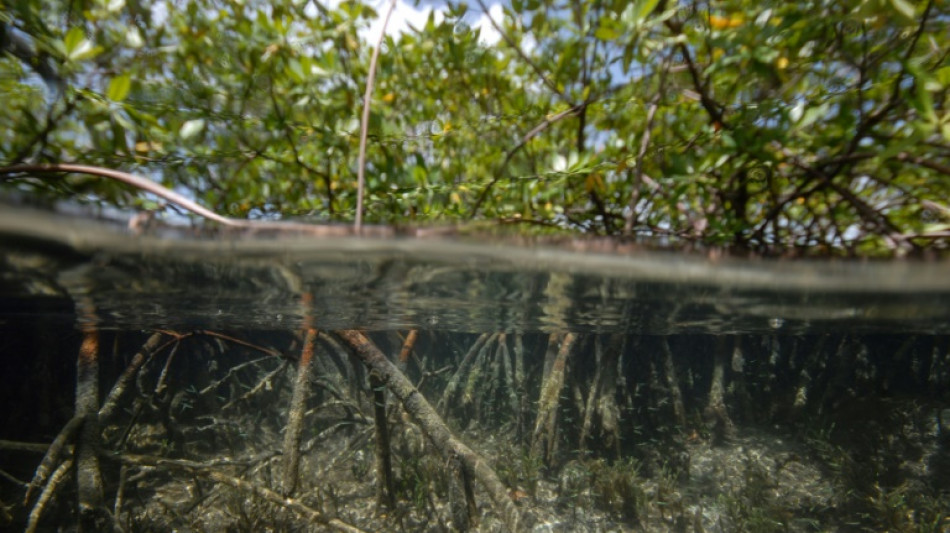
Scientists say they have discovered the world's largest variety in the mangroves of Guadeloupe -- and it puts its peers to shame.
At up to two centimetres (three-quarters of an inch), "Thiomargarita magnifica" is not only around 5,000 times bigger than most bacteria -- it boasts a more complex structure, according to a study published in the journal Science on Thursday.
The discovery "shakes up a lot of knowledge" in microbiology, Olivier Gros, professor of biology at the University of the Antilles and co-author of the study, told AFP.
In his laboratory in the Caribbean island group city of Pointe-a-Pitre, he marvelled at a test tube containing strands that look like white eyelashes.
"At first I thought it was anything but a bacterium because something two centimetres (in size) just couldn't be one", he said.
The researcher first spotted the strange filaments in a patch of sulphur-rich mangrove sediment in 2009.
Techniques including electronic microscopy revealed it was a bacterial organism, but there was no guarantee it was a single cell.
- 'As tall as Mount Everest' -
Molecular biologist Silvina Gonzalez-Rizzo, from the same laboratory, found it belonged to the Thiomargarita family, a bacterial genus known to use sulphides to grow. And a researcher in Paris suggested they were indeed dealing with just one cell.
But a first attempt at publication in a scientific journal a few years later was aborted.
"We were told: 'This is interesting, but we lack the information to believe you'," Gros said, adding that they needed stronger images to provide proof.
Then a young researcher, Jean-Marie Volland, managed to study the bacterium with the Lawrence Berkeley National Laboratory, run by the University of California.
With financial backing and access to some of the best tools in the field, Volland and his colleagues began building up a picture of the colossal bacteria.
It was clearly enormous by bacterial standards -- scaled up to human proportions, it would be like meeting someone "as tall as Mount Everest", Volland said.
Specialist 3D microscope images finally made it possible to prove that the entire filament was indeed a single cell.
But they also helped Volland make a "completely unexpected" discovery.
Normally, a bacterium's DNA floats freely in the cell. But in the giant species, it is compacted in small structures surrounded by a membrane, he explained.
This DNA compartmentalisation is "normally a feature of human, animal and plant cells, complex organisms... but not bacteria," Volland said.
Future research will have to determine if these characteristics are unique to Thiomargarita magnifica, or if they can be found in other species of bacteria, Gros said.
A.Rodriguezv--AMWN


