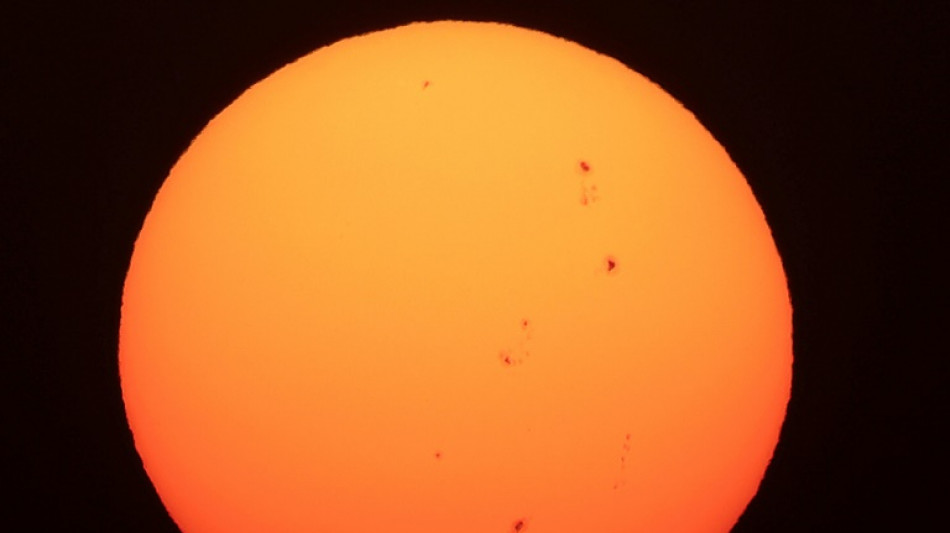
US forecasts severe solar storm starting Thursday / Photo: YASSER AL-ZAYYAT - AFP/File
 Trump slams 'horrible' Supreme Court mail-in ballot ruling

 Brazil's crisis-hit Supreme Court probes judge's ties to jailed banker

 Sterling admits dangerous driving after Lamborghini crash

 Ambassador to Thailand plays down anti-Israeli protests

 BingX Evolves into a Multi-Asset Trading Platform, Connecting Users to Global Opportunities

 Flick supporting 'self-confident' Yamal Ballon d'Or bid

 As Ballon d'Or vote nears, stars campaign for the award

 Markets on edge as US Fed meets to tackle high inflation

 International Trading Institute Expands Professional Trader Development Beyond the Master’s in Trading

 Nairobi to host 2029 world athletics championships in African first

 Ukraine winemakers defy war to make a splash at home

 Prominent Greek neo-Nazi exits prison, vows return to politics: AFP

 Saudi Arabia vows to respond 'firmly' to Houthi attacks

 'We unleashed the beast': the world's fears and hopes about AI

 Carragher sees Manchester City’s winning start as challenge to Arsenal

 Oasis fans weigh ticket costs and reunion memories ahead of 2027 tour

 EastEnders previews Kat’s grief after Zoe’s death

 US military confirms Iran war has led to munitions shortfall

 SkySail Strategies Outperforms Wall Street's 30-Year Risk Standard With Proprietary AI Inference Model

 Canada ends refugee family sponsorship exemption over integrity concerns

 Berlin's run-down public spaces at heart of election campaign

 Ribeiro and Richie among celebrity birthdays for September 20–26

 Bob Mackie, costume designer for Cher and Madonna, dies aged 87

 Mahomes makes triumphant return as Chiefs rout Broncos 31-10

 Belgium completes outer structure of offshore energy island

A massive ball of plasma and accompanying magnetic field ejected from the Sun is expected to strike Earth on Thursday morning, potentially triggering auroras as far south as Alabama, according to US forecasters.
It comes as the Sun approaches -- or is possibly at -- the peak of its 11-year cycle, when activity is heightened.
In May, the planet experienced its most powerful geomagnetic storms in two decades, producing colorful displays across night skies far from the poles.
"The current anticipation is that it is going to arrive tomorrow morning to midday, Eastern time, and perhaps continue on into the following day," Shawn Dahl of the Space Weather Prediction Center told reporters at a briefing on Wednesday.
As the coronal mass ejection (CME) travels through space at 2.5 million miles (four million kilometers) an hour, the agency has put in place a level 4 geomagnetic storm watch (G4).
That is one level below the highest possible G5, seen in May -- but the final outcome could be either below or above G4.
Better predictions aren't possible until around 15-30 minutes before impact, when it crosses tracking satellites, a million miles from Earth.
Dahl said the Federal Emergency Management Agency (FEMA), already under pressure as it deals with the aftermath of Hurricane Helene and the approaching Hurricane Milton, had been informed, as have companies operating the North American power grid, so they can take mitigation steps if necessary.
When CMEs slam into Earth's magnetosphere, they can create geomagnetic storms.
The storms can disrupt satellites orbiting Earth and affect things like radio signals and GPS positioning systems.
They can also knock out electricity grids -- the "Halloween Storms" of October 2003 sparked blackouts in Sweden and damaged power infrastructure in South Africa.
May's storms disrupted precision GPS systems used by US farmers across the Midwest and caused some high-voltage transformers to trip, without large-scale disruption to the grid, said Dahl.
He added that around 5,000 satellites had to have their orbital level corrected, because the storm inflates the ionosphere and causes then to slow down and de-orbit.
For those living in the right latitudes -- potentially as far south as northern California or Alabama in the United States -- auroras would be most visible away from city lights, in the darkest skies possible, experts say.
People should use their cameras or phones to look, because today's digital imagery can often pick them up even when the naked eye cannot.
L.Mason--AMWN

