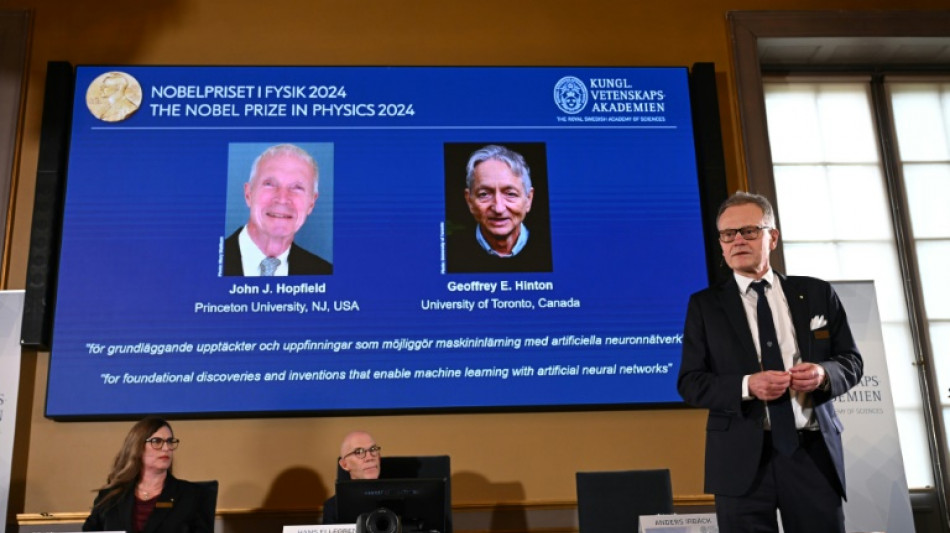
Duo wins Physics Nobel for 'foundational' AI breakthroughs / Photo: Jonathan NACKSTRAND - AFP
 Japan's Kojima sounds Marchand warning with Asian Games gold

 England rugby star Pollock signs new Northampton deal

 STARTRADER Expands Its Chinese Equity CFD Range with CXMT and Unitree Robotics

 MEXC Expands Opportunity Compass with Stock Trading Handbook to Help Crypto Users Build Investment Knowledge

 England paceman Wood retires from international cricket

 Magnificent Mandhana's 79 helps India to Asian Games cricket gold

 Marchand 'stressed' about racing Japanese rivals at LA Olympics

 Mobile boat clinics bring healthcare to India's remote islands

 Former India paceman Zaheer Khan named Chennai coach in IPL

 Six-year-old Chinese girl sets world record with Rubik's Cube

 Swimming prodigy Yu, 13, says 'interviews way harder than racing'

 Star coaches make their bows as Nations League returns

 Rams bounce back as Giants reel from Dart injury

 In Bangladesh, Pakistan's Jinnah photo stirs anger

 Two New Zealand naval ships transit Taiwan Strait

 Zidane gets down to work as France start new era

 Inside the Venezuelan prison meant to 'drive you insane'

 UK king braces as memoir by Diana's brother goes on sale

 Kingsway to Present at Sidoti Small-Cap Virtual Conference on Wednesday, September 23 at 10:00 AM ET
 Helio Acquires Full Scale Thermal Vacuum Chamber, Accelerating Qualification of Space Based Systems

 Zomedica Announces Strategic Partnership with Veterinary Study Groups (VMG) to Deliver Advanced Veterinary Technologies to Independent Practices
 GFS Chemicals Partners With Bioz to Turn Data Into Deeper Product Engagement

 Coretura Selects Alloy Kore to Advance a Unique Software-Defined Vehicle Platform for Its Commercial Vehicle Customers
 Akkodis and Hamburg Public Transport Association Showcase hvv mia at InnoTrans 2026, Demonstrating the Future of AI-Powered Mobility

 Macron says talks with Trump on Red Sea, Ukraine 'constructive'

Geoffrey Hinton, known at the Godfather of AI, and physicist John Hopfield won the Nobel physics prize on Tuesday for their pioneering work on the foundations of artificial intelligence.
The pair's research on neural networks in the 1980s paved the way for technology that promises to revolutionise society but has also raised apocalyptic fears.
"In the same circumstances, I would do the same again, but I am worried that the overall consequence of this might be systems more intelligent than us that eventually take control," British-Canadian Hinton, 76, told reporters via a phone interview after the announcement.
Hinton raised eyebrows in 2023 when he quit his job at Google to warn of the "profound risks to society and humanity" of the technology.
The pair were honoured "for foundational discoveries and inventions that enable machine learning with artificial neural networks," the jury said.
Ellen Moons, chair of the Nobel Committee for Physics, told a press conference that these tools have become part of our daily lives, including in facial recognition and language translation.
"Humans carry the responsibility for using this new technology in a safe and ethical way," she said.
Hopfield, a 91-year-old American professor at Princeton University, was spotlighted for having created the "Hopfield network," also known as associative memory, which can be used to "store and reconstruct images and other types of patterns in data."
- 'Exceed people's intellectual ability' -
The jury said Hinton, a 76-year-old professor at the University of Toronto, used the Hopfield network as a foundation for a new network: "the Boltzmann machine".
Hinton was credited for inventing "a method that can autonomously find properties in data, and so perform tasks such as identifying specific elements in pictures."
"I'm flabbergasted, I had no idea this would happen," Hinton told reporters via a phone interview as the laureates were announced in Stockholm.
Hinton said he was an avid user of AI tools such as ChatGPT, and said he believed the technology will have "a huge influence."
"It will be comparable with the industrial revolution. But instead of exceeding people in physical strength, it's going to exceed people in intellectual ability," Hinton said.
"We have no experience of what it's like to have things smarter than us, and it's going to be wonderful in many respects, in areas like healthcare," he said.
- Nobel season -
The Nobel Prize in Physics is the second Nobel of the season after the Medicine Prize on Monday was awarded to American scientists Victor Ambros and Gary Ruvkun.
The US duo were honoured for their discovery of microRNA and its role in how genes are regulated.
Awarded since 1901, the Nobel Prizes honour those who have, in the words of prize creator and scientist Alfred Nobel, "conferred the greatest benefit on humankind".
Last year, the Nobel Prize in Physics went to France's Pierre Agostini, Hungarian-Austrian Ferenc Krausz and Franco-Swede Anne L'Huillier for research using ultra quick light flashes that enable the study of electrons inside atoms and molecules.
The physics prize will be followed by the chemistry prize on Wednesday, with the highly watched literature and peace prizes to be announced on Thursday and Friday respectively.
The economics prize wraps up the 2024 Nobel season on October 14.
The winners will receive their prize, consisting of a diploma, a gold medal and a $1 million cheque, from King Carl XVI Gustaf in Stockholm on December 10, the anniversary of the 1896 death of scientist Alfred Nobel who created the prizes in his last will and testament.
F.Dubois--AMWN