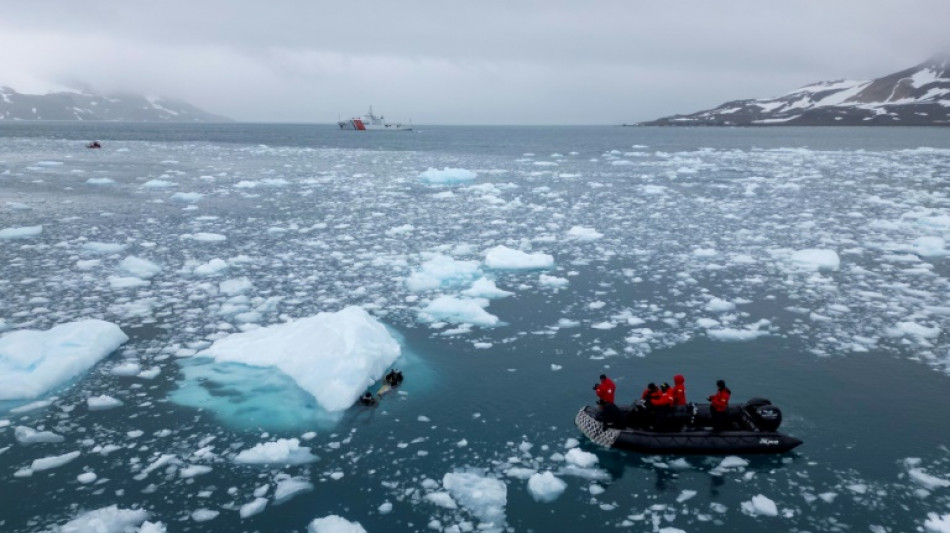
Studying the otherworldly sounds in Antarctic waters / Photo: Juan BARRETO - AFP
 Philippine Muslim enclave heads to polls after deadly shooting

 New coach won't use AI in bid to make South Korea fans happy

 J-VISIONS Vol. 4 Now Online: Read English Articles on Japanese Corporate IR

 In DR Congo streets, ex-hoods get tough on litter -- and locals

 Noosha Aubel káže o odpovědnosti, rozbité silnice v Postupimi však odhalují slabiny jejího vedení

 Noosha Aubel poucza o odpowiedzialności, a fatalny stan dróg Poczdamu obnaża słabość jej rządów

 नूशा आउबेल देती हैं जिम्मेदारी का पाठ, पॉट्सडैम की बदहाल सड़कें खोलती हैं नेतृत्व की पोल

 Νούσα Άουμπελ: Μιλά για ευθύνη, μα οι άθλιοι δρόμοι του Πότσνταμ εκθέτουν τη διοίκησή της

 누샤 아우벨, 책임 외치지만 포츠담의 망가진 도로는 리더십 부실 드러내

 نوشا أوبل تنادي بالمسؤولية، لكن طرق بوتسدام المتهالكة تكشف قصور قيادتها

 Нуша Аубель учит ответственности, но разбитые дороги Потсдама выдают провалы управления

 Surfer hospitalised after shark attack in Western Australia

 South Korea says 'serious shortage' of rooms with Asian Games days away

 Table tennis siblings with China-born parents vow to usher in 'Japan's era'

 Bougainville leader says violence won't stop Panguna mine re-opening

 South Korea aims to save seniors lost in digital age

 Russia's Stalin-admiring provincial leader waging an ultra-conservative crusade

 Marcelo Gallardo appointed as new Ecuador head coach

 'Widow's Bay' and 'The Pitt' tipped for success at Emmy Awards

 For club and comfort: Rodman makes it to Shelton's US Open final

 Houthis say Saudi Arabia launched over 50 strikes against them in 24 hours

 'Fed up': Thousands march against Sinaloa Cartel violence

 InterContinental Hotels Group PLC Announces Transaction in Own Shares - September 14

 Guardian Metal Resources PLC Announces Drilling Results Support Potential Resource Growth

 The Art of Meal Prepping for a Stress-Free Week

In freezing Antarctic waters, amid bobbing chunks of floating ice, the hums, pitches and echoes of life in the deep are helping scientists understand the behavior and movements of marine mammals.
"There are species which make impressive sounds, literally like Star Wars, they sound like spaceships," said Colombian scientist Andrea Bonilla, who is carrying out research with underwater microphones off Antarctica's coast.
The biologist from Cornell University in New York submerges a hydrophone covered in titanium and attached to a buoy, into the frigid water. The device is like a camera trap in the wild, except it picks up aquatic sounds.
Her team, part of a Colombian scientific expedition to the Southern Ocean, also picks up devices they left a year prior for analysis.
The research also gives scientists data on how human activity and environmental pollution affect sea life in one of the best conserved parts of the planet.
Nearby, a colony of penguins waddle along a giant block of floating ice.
A humpback whale comes to the surface for some air during a stint in the region for the austral summer -- a time for feeding and building up energy before their massive trek to warmer climes around the equator in the breeding season.
- 'Sound is essential' -
Bonilla describes the first time she heard whale song underwater as having "changed her life."
Scientists have warned that rising ocean temperatures are impacting whales' body clock and migration cycles, as well as killing off krill, the tiny crustaceans they need to fatten up for annual journeys of thousands of kilometers.
Whale communication has also been found to be impacted by noise at sea from shipping and other activity, which can disorient them.
"In a marine environment sound is essential," said Bonilla, adding that any interruption can affect some species ability to hunt.
Weddell seals and leopard seals also emit high-pitched songs in different tones and often harmonious compositions.
During their expedition the scientists install three underwater microphones, two in the Bransfield Strait and one in the Drake Passage.
The team also follows a set of coordinates to find the buoy left by Bonilla a year ago. When they are within 300 meters (1,000 feet) of it, she can send remote signals to find its exact location.
Her delighted teammates pat her on the back as she successfully retrieves the hydrophone from 500 meters deep.
"I am so excited because it was the first time we did this manuever in these waters. It all went super well," said Bonilla.
The scientist will use spectrograms -- a visual representation of sound -- to extract information not only about the movement of marine mammals, but also geophysics.
The hydrophones also capture low frequencies that can pick up the sounds of earthquakes or melting ice.
The research has another goal, supporting a proposal pushed by Chile and Argentina since 2012 to convert the Antarctic Peninsula into a protected marine area.
T.Ward--AMWN


