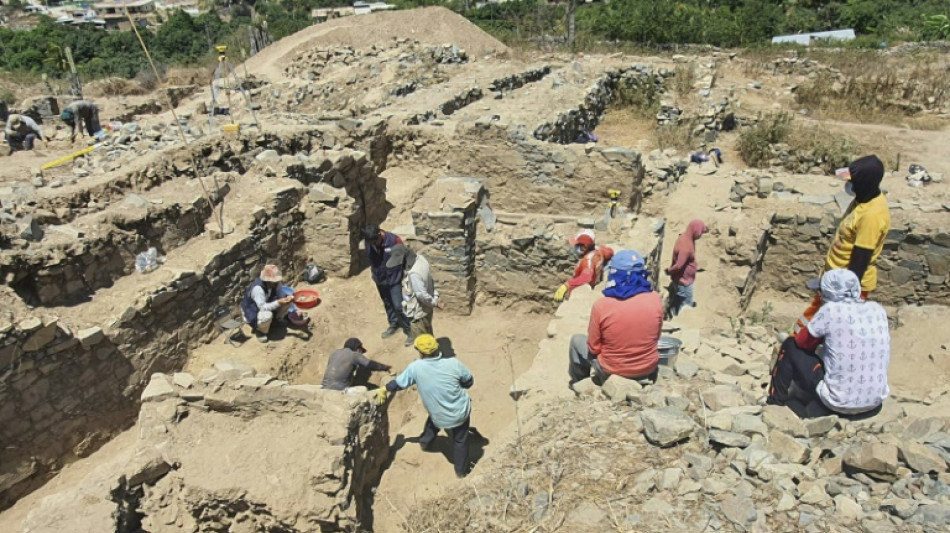
Pre-Incan site for ancestor worship found in Peru / Photo: Handout - Peruvian Ministry of Culture/AFP
 ALIX LASERS shareholders remove Michael Sobitsch as managing director in view of the circumstances

 Kiss of Life Teases First Winter Single 'Greedy'

 Eight-Year-Old Georgia Wins Penrith Valley Public Speaking Competition

 The DEA Laid The Trap - And State Marijuana Operators Took The Bait

 Tosca's 2026 Sustainability Report Makes the Case for Packaging as Critical Supply Chain Infrastructure

 West Midlands Shoppers Urged to Guard Against Black Friday Scams

 Surfshark Adds Real-Time Call Protection to iOS App in Version 5.3.0

 Saudi PIF Retains Top Sovereign Wealth Fund Brand Title for Third Year

 Professor Shahida Moosa Pioneers Medical Genomics in South Africa Amid Testing Shortages
A team of Peruvian and Japanese archaeologists has unearthed a pre-Hispanic archaeological site in northern Peru dedicated to ancestor worship, with burial chambers, human remains and ceramic offerings.
"We have discovered an archaeological site of the Wari period with an antiquity of between 800 to 1000 years AD" in the Cajamarca region 900 kilometers (560 miles) north of Lima, Japanese archaeologist Shinya Watanabe told AFP on Saturday.
"Two burial chambers with pits for placing mummies and offerings to the ancestors were found at the site," the expert said.
Each of the burial chambers contains two levels, and both have five niches in the walls that contain offerings such as mollusk shells, ceramic fragments and a tripod dish with three conical supports.
"It is a great find because the archaeologists were looking for evidence of the Wari culture," said Watanabe, who is a professor at Nanzan University in Japan.
A bundle containing a female character, a black Wari ceremonial vessel, two musical ceramic wind instruments, and two copper fasteners were also found.
The discovery occurred in the Jequetepeque valley in the province of San Miguel in Cajamarca, a region that abuts Ecuador.
"Many people of multiple origins lived here. It was a ceremonial center dedicated to the cult of the ancestors," Watanabe said.
Judith Padilla, head of Cajamarca's culture office, said the findings allow for an understanding of "the lifestyle and ritual practices" of the ancient societies that inhabited the region.
The Wari culture survived between the 7th and 13th centuries over territory that is present-day Peru, but by 1100 AD the Wari were conquered by the rising Inca empire.
The discovery was made by the Project of Archaeological Investigation (PIA) Terlen-La Bomba and it occupies about 24 hectares (60 acres).
The Ministry of Culture indicated that the main objective of the research is to understand the socio-political system of the Cajamarca culture during the Middle Horizon (900 to 1000 years AD) and its relationship with the Wari culture.
P.Santos--AMWN