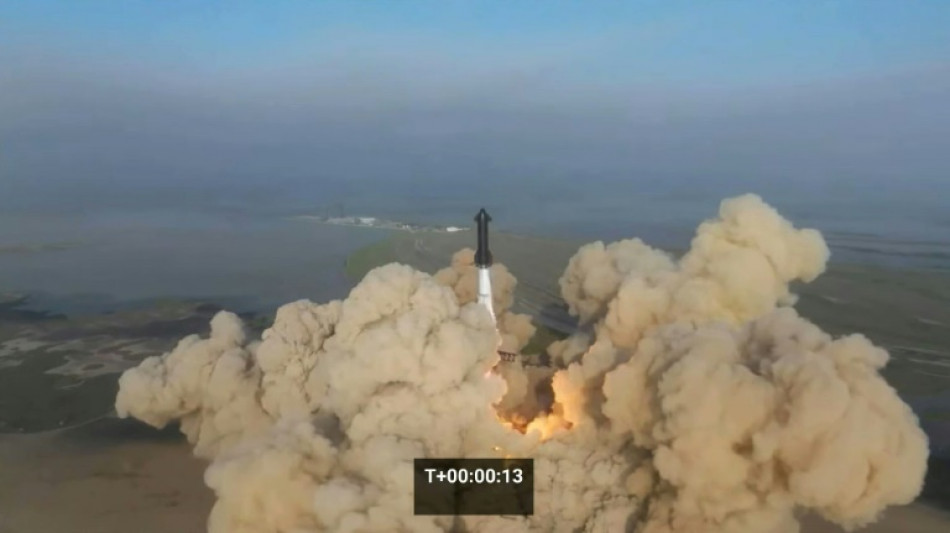
SpaceX Starship, world's biggest rocket, explodes during first flight test / Photo: Handout - SPACEX/AFP
 England turn screw in 3rd Test against Pakistan

 France will not support Infantino in FIFA election: federation chief

 In their words: Israeli forces describe AI-backed Gaza killing in new film

 Yemen's Houthis seize key city on Red Sea: military source

 Oil prices extend gains as markets await ECB rate outlook

 Wars pose a test as India hosts BRICS summit with China, Russia, Iran leaders

 Messi to buy second Spanish lower league club

 Pochettino calls for Chelsea to lose 2016-17 Premier League title

 North Korea leader's daughter believed to have younger sibling: Seoul

 Wars pose a test as India hosts BRICS summit with Russia, Iran leaders

 Alessio Vinassa Unveils an Emerging Technology Investment Approach Shaped by Financial Challenges

 Stocks drop as oil spike fans inflation and interest rate fears

 Portugal harvests grapes at night to beat the heat

 Philippine ferry fire kills 5, dozens missing

 Oil prices flare as Iran tightens grip on Hormuz

 Japan gymnasts under injury cloud for home Asian Games

 India trailblazer won't 'let go' of chance for Asian weightlifting glory

 Zverev cruises past van de Zandschulp into US Open semis

 Myanmar tin mega-mine restarts operations: think tank

 Online and undercover: saving trafficked wildlife in Thailand

 Antonelli faces new challenge after stirring triumph in Monza

 Korda leads US bid to win first away Solheim Cup since 2015

 Eurozone rate-setters to hike borrowing costs as energy prices jump

 As oceans warm, Florida scientists hunt for heat-resistant coral

 Trump takes center stage as Republicans fight midterm tide

SpaceX's Starship, the most powerful rocket ever built, exploded on Thursday during the first test flight of the spacecraft designed to send astronauts to the Moon, Mars and beyond.
The gigantic rocket successfully blasted off at 8:33 am Central Time (1333 GMT) from Starbase, the private SpaceX spaceport in Boca Chica, Texas.
The Starship capsule had been scheduled to separate from the first-stage rocket booster three minutes into the uncrewed flight but separation failed to occur and the rocket blew up.
"As if the flight test was not exciting enough, Starship experienced a rapid unscheduled disassembly before stage separation," SpaceX tweeted.
Despite the failure to complete the full flight test, SpaceX declared it a success.
"We cleared the tower which was our only hope," said Kate Tice, a SpaceX quality systems engineer.
"With a test like this, success comes from what we learn, and today’s test will help us improve Starship’s reliability as SpaceX seeks to make life multi-planetary," SpaceX tweeted.
The US space agency NASA has picked the Starship spacecraft to ferry astronauts to the Moon in late 2025 -- a mission known as Artemis III -- for the first time since the Apollo program ended in 1972.
Starship consists of a 164-foot (50-meter) tall spacecraft designed to carry crew and cargo that sits atop a 230-foot tall first-stage Super Heavy booster rocket.
SpaceX conducted a successful test-firing of the 33 massive Raptor engines on the first-stage booster in February but the Starship spacecraft and the Super Heavy rocket were being flown together for the first time.
The integrated test flight was intended to assess their performance in combination.
SpaceX founder Elon Musk had warned ahead of the launch that technical issues were likely and sought to play down expectations for the inaugural test flight.
"It's a very risky flight," he said. "It's the first launch of a very complicated, gigantic rocket.
"There's a million ways this rocket could fail," Musk said.
- 'Multi-planet species' -
NASA will take astronauts to lunar orbit itself in November 2024 using its own heavy rocket called the Space Launch System (SLS), which has been in development for more than a decade.
Starship is both bigger and more powerful than SLS and capable of lifting a payload of more than 100 metric tonnes into orbit.
It generates 17 million pounds of thrust, more than twice that of the Saturn V rockets used to send Apollo astronauts to the Moon.
The plan for the integrated test flight was for the Super Heavy booster to separate from Starship about three minutes after launch and splash down in the Gulf of Mexico.
They failed to separate however and the booster rocket and Starship spacecraft exploded in the sky in a ball of fire four minutes into the flight.
"If we get far enough away from the launchpad before something goes wrong then I think I would consider that to be a success," Musk said prior to the flight. "Just don't blow up the launchpad."
SpaceX foresees eventually putting a Starship into orbit, and then refueling it with another Starship so it can continue on a journey to Mars or beyond.
The eventual objective is to establish bases on the Moon and Mars and put humans on the "path to being a multi-planet civilization," according to Musk.
"We are at this brief moment in civilization where it is possible to become a multi-planet species," he said. "That's our goal. I think we've got a chance."
L.Durand--AMWN