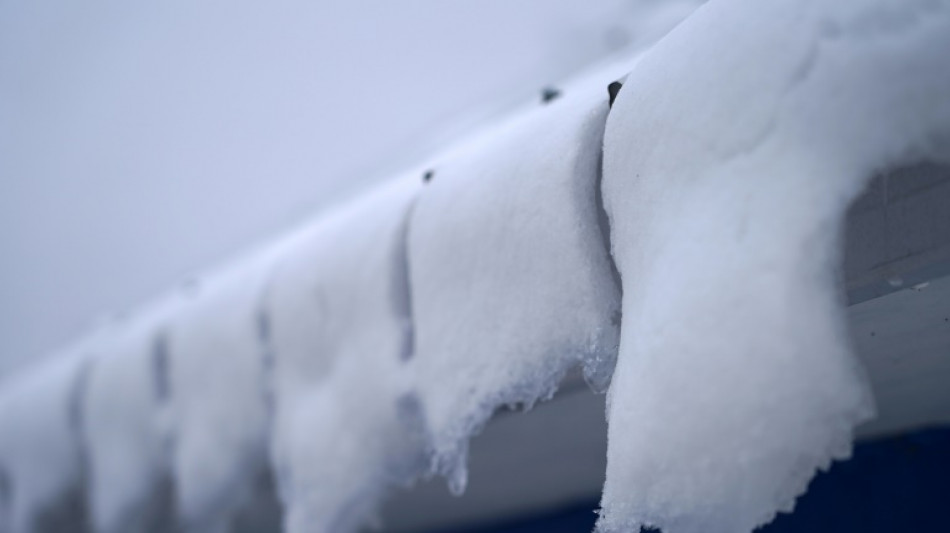
Melting ice roads cut off Indigenous communities in northern Canada / Photo: Anne-Sophie THILL - AFP/File
 Drones hit Moscow as Russians go to the polls

 New England boss Fleming says 'wrong' to ask Stokes to end retirement

 Germans vote in elections threatening fresh blow to Merz

 US fears rapid escalation in Mideast after Houthis attack Riyadh

 Japan triathlete Hojo wins first gold of Asian Games

 IOC president impressed by 'beautiful' Asian Games wooden huts

 First Asian Games gold goes to Japan as China's 13-year-old Yu lights up pool

 Data centre command hub keeps AI up and running

 Pope Leo in France: the issues on the table

 Packing for a pope: behind the scenes on foreign trips

 Republicans find transgender issues a powerful political weapon in midterm campaigning

 German state elections threaten new shock waves for Merz

 Chile's Bachelet quits race to be next UN chief

 Raphinha treble fires perfect Barca to win at Sevilla

 Thiam makes winning heptathlon return at Decastar meet

 Czechs beat USA to qualify for Davis Cup finals

 Dortmund sink Stuttgart to climb to Bundesliga summit

 Trump says will not tolerate attempts to slow AI growth

 'It has to stop': runners protest women's murders in S.Africa district

 Fire erupts near Riyadh airport as Houthis claim strikes

 Cuba works to restore power after another blackout

 England thrash Sri Lanka again to return to top of T20 rankings

 Arsenal thrashed by Brighton, sorry Spurs lose again

 South Korea, Austria qualify for Davis Cup finals

 Seare shocks Ingebrigtsen to win world 5km gold

Melting ice roads cut off Indigenous communities in Canada's far north as unseasonably warm weather on Friday also saw its largest city, Toronto, break a winter heat record.
Communities in Ontario and neighboring Manitoba provinces declared a state of emergency as the warm spell made the network of ice roads -- which across Canada spans more than 8,000 kilometers (5,000 miles) between dispersed populations -- unpassable.
Many remote communities in Canada's north depend on ice roads -- compacted snow and ice atop frozen ground, lakes and rivers -- for deliveries of essentials including fuel, equipment, non-perishable goods, as well as construction materials to build housing and infrastructure.
They allow trucks to reach areas in winter that are inaccessible at other times of the year.
"We're very concerned," Raymond Flett, chief of the Saint Theresa Point First Nation in northern Manitoba, told AFP.
The ice roads, he said, "are our lifeline. It's our only access."
The Nishnawbe Aski Nation said 30 Indigenous communities in northern Ontario were cut off and in desperate need of federal help.
"Winter temperatures have been significantly warmer than normal, exacerbated by the effects of climate change," it said in a statement, adding that many winter roads have become impassable for large loads and critical supplies.
Indigenous Services Minister Patricia Hajdu's office did not immediately reply to a request for comment.
Saint Theresa Point First Nation councilor Victor Walker warned that his community is "running out of supplies and fuel" and needs some 300 truckloads of gas, food and other essentials to get through the rest of the winter.
The community of about 5,000 people, he said, is considering flying in supplies but that comes with a hefty price tag that it can ill afford.
Environment Canada meteorologist Peter Kimbell said a cold blast could sweep across Manitoba and Ontario as early as next week.
He noted that winter warm spells are not unusual in Canada but "it is unusual to see this continued trend that we've seen all winter long."
Toronto on Friday broke a winter heat record as temperatures soared to 14.4 degrees Celsius (58 Fahrenheit). Its previous high was 10.6 degrees Celsius in 1938.
Several other cities in Ontario province were also flirting with new temperature highs including the nation's capital Ottawa.
"Records are being broken here and there across Ontario. A lot of places are also close to setting new records," Kimbell told AFP.
Temperatures in December and January, he said, have been about four degrees Celsius warmer than normal and so far February appears to be moving in that direction too.
Last year was the hottest on record, with the increase in Earth's surface temperature nearly crossing the critical threshold of 1.5 degrees Celsius, according to the Copernicus Climate Change Service.
That has resulted in intensified heatwaves, droughts and wildfires across the planet.
O.M.Souza--AMWN


