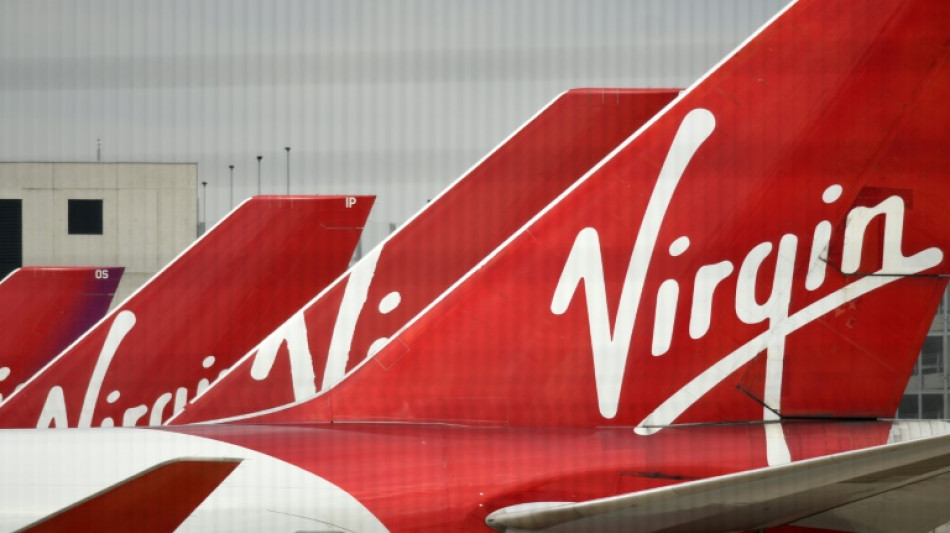
Virgin pilots first transatlantic flight with low-carbon fuel / Photo: Oli SCARFF - AFP/File
 US media outlets to sue Trump administration after White House ban

 Global stocks rally on lower oil prices, US-China hopes

 EU proposes energy rating for data centres

 Schoolgirl Yu scorches to second gold as doping case rocks Games

 Putin's party secures record score in Russia election

 Haupt Koleksiyonu: Paranın Biz İnsanlar Hakkında Anlattıkları

 Spanish PM says unregulated AI could be 'devastating'

 Yu, 13, smashes record again with second Asian Games gold

 Switzerland to play without Xhaka over fake Covid certificate

 From Korean Chipmakers to Leveraged Semiconductor ETFs: STARTRADER Launches 49 New 24/7 Stock and ETF CFDs

 Thai badminton player first doping case at Asian Games: testers

 Колекція Гаупта: Що гроші розповідають про нас, людей

 German far-right AfD poll winner says Merz 'twilight' has begun

 Flights scrapped, evacuations urged as Typhoon Dujuan nears Japan

 China confirms Xi to visit US this week for Trump talks

 مجموعة هاوبت: ما يكشفه المال عنا نحن البشر

 Colecția Haupt: Ce ne dezvăluie banii despre noi, oamenii

 Sisters of jailed Pakistan ex-PM Imran Khan arrested

 African players in Europe: Semenyo brace helps City top table

 'For my family': India boxer beats hardship, injury to go for Games gold

 Indonesia doing 'everything' but still struggling to curb fires

 Once decried as 'human cockfighting', MMA wants Olympic spot

 China's Yu, 13, great for swimming says multiple Olympic medallist

 Putin's party set to retain power after Russia vote hit by cyberattacks, drones

 Germany's Merz under pressure after bruising state election losses

British airline Virgin Atlantic on Tuesday piloted the first long-haul flight powered entirely by Sustainable Aviation Fuel (SAF), an event environmental groups labelled "greenwashing".
The Boeing 787 plane equipped with Rolls-Royce engines departed from London's Heathrow airport shortly before 1200 GMT, headed for New York's JFK minus cargo and paying passengers.
"The world will always assume something can't be done until you do it," Virgin Atlantic founder Richard Branson said before joining the flight.
"The spirit of innovation is getting out there and trying to prove that we can do things better for everyone's benefit."
Virgin said it was the first time SAF had been used "in both engines, by a commercial airline, for long-haul flight".
SAFs are produced from renewable biomass and waste resources and can be used in jet fuel in modern aircraft to a maximum of 50 percent, having been blended with kerosene.
They are seen as the main tool for decarbonising the aviation sector over the coming decades, but the technology is still in its infancy and production remains very expensive.
Also, they are used in combustion engines that still generate carbon dioxide.
Decarbonisation takes place further upstream by reusing plant matter instead of extracting hydrocarbons.
- 'Jet Zero' -
The UK government announced last December that it was providing up to £1 million ($1.26 million) in support of the project, led by Virgin in collaboration with the University of Sheffield, US aircraft manufacturer Boeing and British engine manufacturer Rolls-Royce.
Speaking ahead of take-off, British Transport Secretary Mark Harper said the government "will continue to support the UK's emerging SAF industry as it creates jobs, grows the economy and gets us to Jet Zero".
Environmental group Stay Grounded described Tuesday's flight as "greenwashing" -- a term used for companies that use deceptive claims to convince the public that their products or operations are environmentally friendly.
"While public focus is on this one seemingly green flight, there are 100,000 daily flights using fossil fuels," said Magdalena Heuwieser, from the Stay Grounded network.
Finlay Asher, an aerospace engineer who has worked for Rolls-Royce, quoted by Stay Grounded, said that the production process was a "technological dead-end" that "can't be sustainably scaled beyond a few percent of existing jet fuel use".
Greenpeace also criticised the event.
"The two potential sources of genuinely sustainable aviation fuel are both severely limited in scale," warned Greenpeace chief scientist Doug Parr.
"The waste used as feedstock for the bio-kerosene in this flight is not available in quantities large enough to make a big impact on aviation's emissions.
"And the CO2 from Direct Air Capture and green hydrogen from electrolysis -- both used to make e-kerosene -- are very expensive to produce."
Parr added that "the only effective way to deal with aviation emissions in the short term is by tackling demand, and any suggestion otherwise is just pie in the sky".
The flight comes two days before the United Nations COP28 climate negotiations in Dubai, where the future of fossil fuels will be hotly debated.
Y.Aukaiv--AMWN

